How to Order a Custom Bobble Head in South Africa from a Photo
Learn how to order a custom bobble head in South Africa from your photo. Follow these tips for choosing images, props, clothing, engraving and a personalised theme.
Prepare a clear customisation brief
A personalised figurine can turn an ordinary photograph into a three-dimensional keepsake that celebrates someone's face, career, hobby, and personality. The quality of the final concept, however, depends greatly on the information supplied when placing the order.
Customers searching for custom bobble head South Africa often ask the same practical questions: which photograph should I use, can I include a uniform or hobby, what should be engraved on the base, and how much detail should I request?
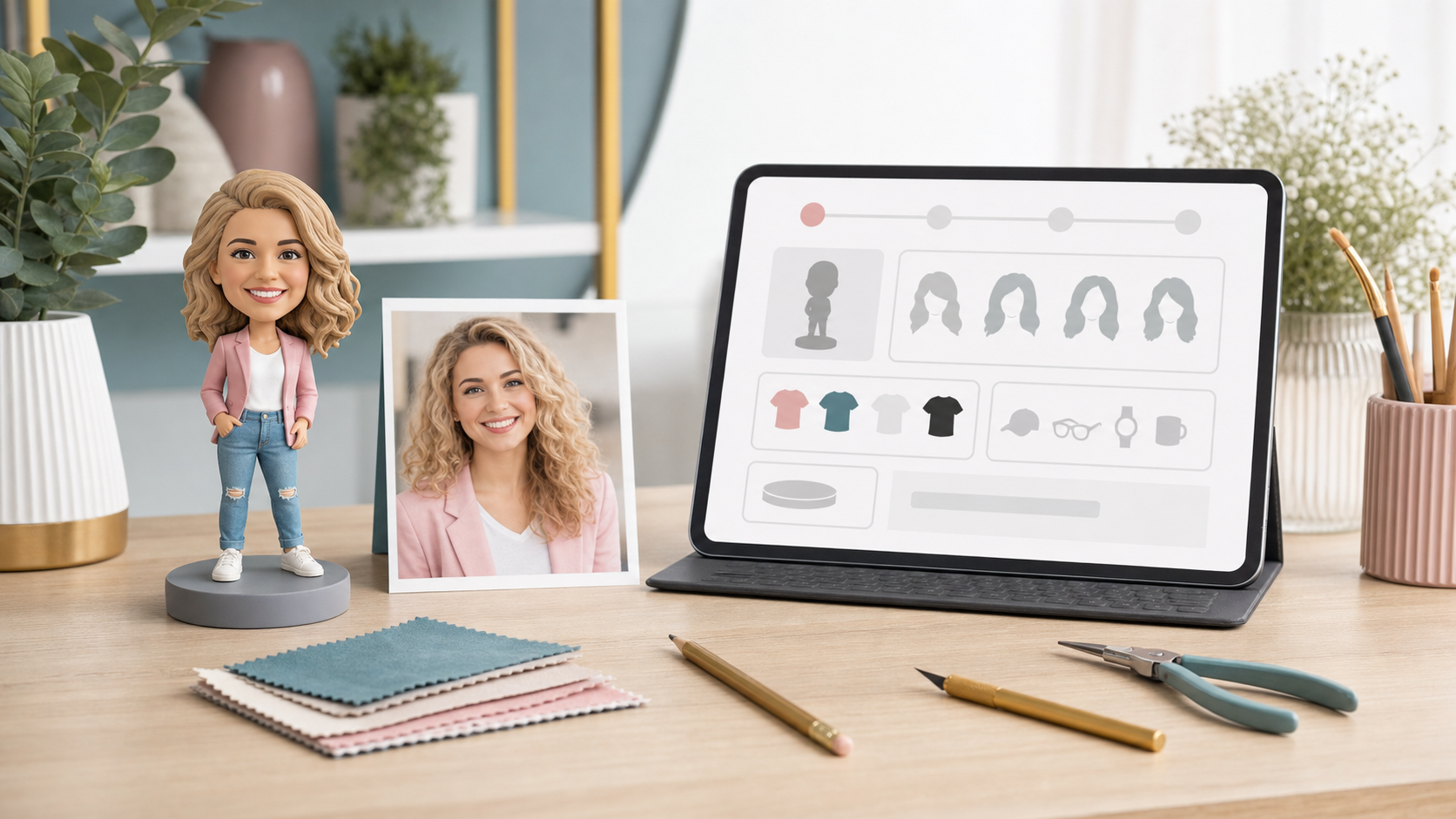
This guide explains how to prepare a clear, useful customisation brief for your Heartfelt Creations portrait figurine.
Open the Personalized Portrait Figurine with your own face in colour while following the steps below.
Step 1: Decide what the figurine should celebrate
Before choosing photographs, decide what the figurine is meant to say about the recipient. The occasion helps determine the clothing, props, pose, and engraving.
For example, a retirement design might focus on the recipient's career while adding one small reference to their retirement plans. A birthday design might focus more on personality and hobbies. A corporate award could emphasise professional clothing, company-related details, and the achievement being recognised.
Choosing a clear purpose at the beginning prevents the design from becoming overcrowded.
- A birthday
- Christmas
- A retirement
- A graduation
- A promotion
- A professional achievement
- A wedding or anniversary
- A favourite hobby
- A business milestone
- A farewell or thank-you
Step 2: Select a strong main photograph
The main photograph is the most important part of the order. It should provide a clear view of the person's face and current appearance.
A simple mobile-phone portrait taken near a window can be more useful than a professional event photograph in which the face is small or partly hidden.
Try to avoid screenshots from social media, heavily compressed images, and cropped group photos. These often lose important detail.
- In focus
- Well lit
- Front-facing or taken at a slight natural angle
- Large enough for facial details to be visible
- Free from strong filters
- Not covered by sunglasses, a hat, or deep shadows
- Recent enough to represent the person accurately
Step 3: Add supporting photographs
One clear portrait may be enough for the face, but supporting photographs can help explain other parts of the design.
Supporting images do not all need to come from the same day. Their purpose is to give the designer a clearer understanding of the person and the requested theme.
When supplying several images, briefly explain what each one demonstrates. For example: use photo one for the face, photo two for the hairstyle, and photo three for the uniform.
This is far clearer than expecting the designer to guess which details matter most.
- A side view of the hairstyle
- A full-length photograph showing build and posture
- The recipient wearing their typical work clothing
- A uniform that should be represented
- A favourite outfit
- A photograph of the tool, instrument, or prop to include
- An example of a characteristic pose
Step 4: Choose one main theme
A strong custom figurine usually has one central theme supported by a few carefully chosen details.
For a profession-themed design, choose the single item that communicates the job most clearly. An architect might hold plans, a photographer a camera, a chef cooking equipment, and a real-estate professional a house-related prop.
For a hobby theme, use an instantly recognisable object such as a golf club, guitar, gardening tool, game controller, or book.
Too many unrelated props can make the concept confusing. The aim is not to include every fact about the person. It is to capture the details that make them recognisable.
- Profession
- Favourite hobby
- Sport
- Personal achievement
- Creative interest
- Retirement
- Graduation
- Business ownership
- Family role
- Travel or adventure
Step 5: Describe the profession or hobby clearly
The product order includes space to provide the recipient's hobby or profession. Use this field to supply concrete details rather than a single vague word.
Instead of writing "engineer", a more useful description would be: civil engineer who usually wears a white hard hat and reflective vest. Please include rolled building plans.
Instead of "gardening", write: keen home gardener who grows roses. Please include a small watering can and gardening gloves.
Instead of "businesswoman", write: owner of a bakery. She normally wears a black apron and is known for decorated celebration cakes.
A short but specific description gives the design direction without making it unnecessarily complicated.
Step 6: Select recognisable clothing
Clothing is an important part of likeness, particularly when the figurine represents a career or hobby.
Where the outfit matters, provide a reference photograph or a simple written description. Colours should be described plainly, such as: dark navy suit, white shirt, and burgundy tie.
This is more useful than asking the designer to choose what the recipient usually wears to work. If the recipient is strongly associated with a particular item, such as colourful glasses, a hat, scarf, or distinctive shoes, mention it.
- Everyday clothing
- Formal business clothing
- A uniform
- Trade or safety clothing
- Sports clothing
- Graduation attire
- A favourite jacket or dress
- Clothing in meaningful colours
Step 7: Choose props that tell the story
Props are the objects included with the figurine to represent the person's work, hobby, or interests.
Effective props are easy to recognise, meaningful to the recipient, closely connected to the main theme, large enough to remain clear at figurine scale, and limited to a sensible number.
One or two strong props are usually more effective than a collection of tiny accessories.
- Books for a teacher or reader
- Plans for an architect
- A camera for a photographer
- A laptop for an office professional
- Tools for a tradesperson
- A golf club for a golfer
- A musical instrument for a musician
- A mixing bowl for a baker
- A paintbrush for an artist
- A sold sign or miniature house for a real-estate professional
Step 8: Write a concise custom note
Use the custom note to explain any instructions that are not obvious from the photographs.
A helpful note might cover the occasion, the recipient's personality, the most important facial feature, which outfit to use, the preferred prop, a pose or expression, and details that should not be included.
For example: this is a 60th birthday gift for my father. Please show him smiling in his usual blue work shirt, holding a small toolbox. He is known for fixing everything around the house.
This gives the designer a clear story and a visual direction. Avoid instructions that conflict with one another or request too many unrelated themes.
Step 9: Plan the base engraving
The base provides space for a short name, date, title, or message.
Short wording is generally easier to read and produces a cleaner result.
Check the spelling of names, titles, and dates carefully before submitting the order. Custom engraving is created from the information supplied.
- The recipient's name
- A nickname
- A job title
- Happy 50th
- Congratulations
- 25 Years of Service
- Class of 2026
- Happy Retirement
- A short phrase associated with the recipient
Step 10: Review the full brief before ordering
Before completing the order, review all the information as though you were seeing the recipient for the first time.
A clear order brief helps translate your idea into a coherent design.
- Is the face clearly visible in the main photograph?
- Have I identified the correct hairstyle and clothing?
- Is the main theme obvious?
- Have I selected only the most meaningful props?
- Is the engraving short and correctly spelt?
- Have I explained which photograph should be used for which detail?
- Does the brief focus on the recipient rather than the occasion alone?
Example customisation briefs
Birthday gift for an architect: please create a colour figurine for her 40th birthday. Use the first photograph for her face and hair. Dress her in the black blazer shown in the second photograph. She is an architect, so please include rolled plans and a small ruler. Engraving: Nadia - Building Dreams.
Retirement gift for a teacher: this is a retirement gift after 35 years of teaching. Please show him wearing a light-blue shirt and glasses, holding two books. He is known for teaching mathematics. Engraving: Mr Jacobs - 35 Inspiring Years.
Christmas gift for a golfer: please create a fun colour figurine using the attached portrait. Show her in a golf shirt and cap, holding a golf club. Please keep the design focused on golf. Engraving: Queen of the Green.
Corporate recognition gift: this figurine is for an employee receiving a long-service award. Please use formal business clothing and include a laptop and file. Use the company colours as small accents where practical. Engraving: Thabo - 20 Years of Excellence.
These examples are detailed enough to guide the concept without overwhelming it.
Why 3D printing works well for personalised figurines
3D printing allows a digital design to be produced as a physical object in carefully built layers. It is well suited to custom products because each figurine can be created for an individual recipient rather than manufactured as part of a large identical batch.
Heartfelt Creations uses high-quality 3D-printed PLA for its portrait figurines. PLA is commonly used for detailed decorative items and allows the finished piece to combine form, colour, and personalised features.
As with any boutique custom creation, small variations may occur. These differences are part of the individuality of a made-to-order figurine.
Ordering locally in South Africa
A local customisation process can make it easier to explain professions, hobbies, wording, and references that are familiar in South Africa.
When looking for a custom bobble head in South Africa, consider whether the supplier allows you to upload your own photograph, describe the recipient's profession or hobby, add a custom note, include base engraving, communicate the purpose of the gift, and order a colour, display-ready design.
The Heartfelt Creations product page provides these personalisation fields so that the order is built around your own concept.
Start with a clear photo and a meaningful story
The best personalised figurines begin with two things: a clear visual reference and a strong understanding of what makes the recipient special.
Choose a photograph that shows the face properly. Select one main theme. Describe meaningful clothing and props. Keep the engraving short. Most importantly, explain the story you want the figurine to tell.
For customers looking to order a custom bobble head South Africa design, Heartfelt Creations provides a locally produced option that turns photographs and personal details into a colourful three-dimensional keepsake.
Upload your photograph and create a personalised portrait figurine.
Frequently asked questions
Can you make a custom bobblehead from one photograph?
A clear, front-facing photograph may provide enough information for the face. Additional photographs are helpful when hairstyle, outfit, build, props, or profile details are important.
What photograph quality is best?
Use a sharp, well-lit, and recent image in which the face is large enough to see clearly. Avoid heavy filters, dark shadows, and distant group shots.
Can I choose the clothing?
Yes. Describe the clothing and provide a reference image when possible. Uniforms, professional outfits, sports clothing, and favourite everyday outfits can all help communicate the theme.
Can I include a hobby and a profession?
It may be possible, but one should usually be the main theme. A small supporting detail can represent the second interest without overcrowding the design.
What should I put on the base?
A name, date, title, or short message works best. Keep the wording concise and check the spelling carefully.
How early should I order?
Custom products require design and production time. Order well ahead of fixed occasions such as birthdays, Christmas, retirements, and corporate events.